
Replacing a missing tooth is about more than filling a visible gap. If you’re considering how to replace a missing tooth, the main options include a dental implant, an implant-supported bridge, a removable partial denture, or a tooth-supported bridge. Each offers a different balance of stability, convenience, and care.
It’s understandable to feel unsure where to start, especially when the choices sound similar. A missing tooth can affect how comfortable you feel eating and smiling, so learning about replacement options can make the next step feel clearer. This guide compares how each option works, what it’s designed to replace, and the practical differences to consider. You’ll also see why replacing a tooth may matter beyond appearance, and how the number of missing teeth and the teeth around the gap can shape the options. With a clearer picture, you can have a more informed conversation about which approach feels right for you.
Key Takeaways
- Compare fixed and removable replacements by how many teeth need replacing and how you want the new tooth to feel in everyday use.
- An implant-supported bridge can replace several teeth, while the number of supporting implants depends on the bridge design.
- A single-tooth implant replaces the tooth root and supports a crown; healing and available jawbone are important parts of treatment planning.
- A removable partial denture is taken out for cleaning and may suit a different set of needs than a fixed replacement.
Implant-supported bridges
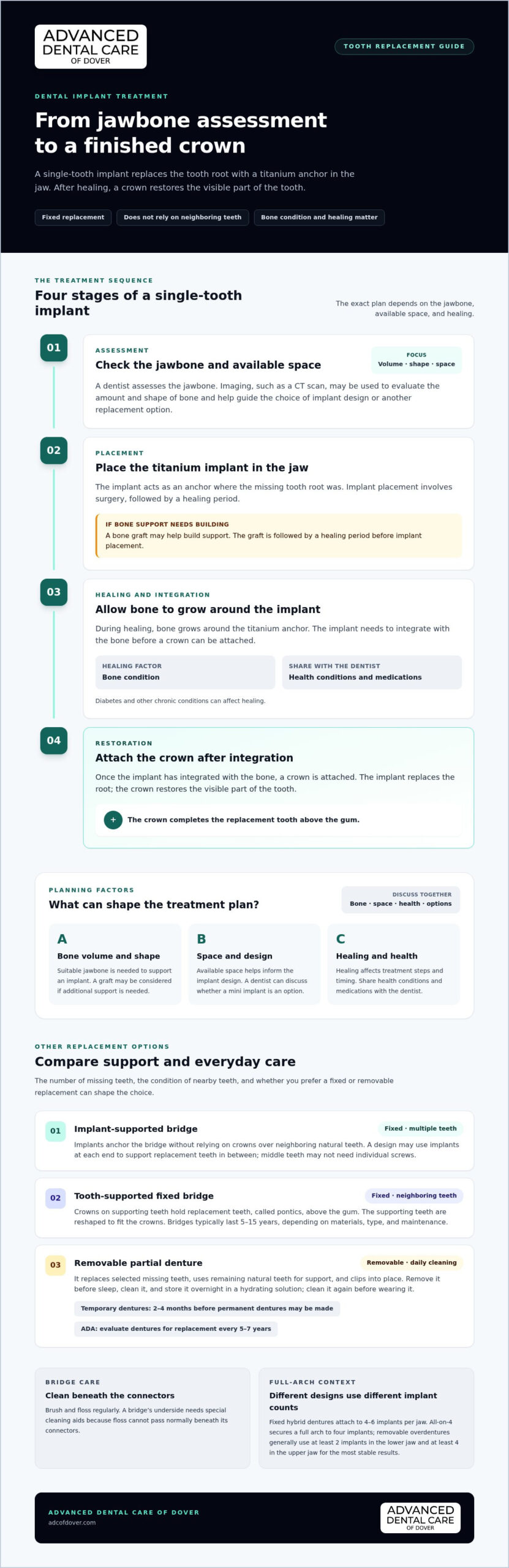
An implant-supported bridge can replace several missing teeth without relying on crowns placed over neighboring natural teeth. Implants anchor the bridge, and a design may use implants at each end to support the replacement teeth in between. Those middle teeth can be supported without individual screws.
A tooth-supported bridge relies on neighboring teeth for support. A fixed bridge typically uses crowns on the supporting teeth to hold replacement teeth, called pontics, above the gum. Preparing this option involves reshaping the supporting teeth to fit the crowns. Treatment generally involves visits for imaging, impressions, tooth preparation, a temporary bridge, and final placement.
For multiple missing teeth, bridge length matters: the more teeth replaced, the more natural teeth or implants are needed for support. Dental bridges typically last 5-15 years, depending on materials, type, and maintenance. The right design also depends on the condition of the supporting teeth and available bone.
Implants, bridges, and partial dentures each have different considerations. Implant placement involves surgery and healing, while a tooth-supported bridge requires altering neighboring teeth. Removable partial dentures need daily cleaning and are removed before sleep, so consider the care involved with each option.
Keep a restoration clean with regular brushing and flossing. A bridge’s underside needs special cleaning aids because floss cannot pass normally beneath its connectors. Clean removable dentures separately each day, and follow the dentist’s care instructions for implants and the surrounding gums.
| Option | Support | Key consideration |
|---|---|---|
| Implant-supported bridge | Dental implants | Can replace multiple teeth |
| Tooth-supported fixed bridge | Crowned neighboring teeth | Support teeth are prepared |
| Removable partial denture | Remaining natural teeth | Removed for daily cleaning |
Compare how many teeth need replacing, the health of nearby teeth, and whether you prefer a fixed or removable option.
Dental implants
A dental implant replaces a tooth root with a titanium anchor in the jaw and supports a replacement tooth. Bone condition and healing affect the treatment steps and timing.
Single-Tooth Implant Treatment
For one missing tooth, an implant supports a crown without relying on neighboring teeth for support. The implant replaces the root, while the crown restores the visible part of the tooth after healing. A dentist can discuss whether a mini implant is an option. A dentist considers the available bone and the space before choosing between implant designs and other replacement options.
Implant Placement Steps
Getting a dental implant starts with an assessment of the jawbone. A dentist may use imaging, such as a CT scan, to evaluate its amount and shape. The titanium implant is placed in the jaw, where bone grows around it during healing. Once the implant has integrated with the bone, a crown can be attached to restore the tooth.
Implant Candidacy and Bone Grafting
Whether you are a suitable candidate for a dental implant depends partly on whether the jawbone has enough suitable volume and shape to support it. If bone augmentation is needed, a graft may help build support, followed by a healing period before implant placement. Diabetes and other chronic conditions can affect healing, so tell the dentist about your health conditions and medications.
Implants are fixed, unlike a removable partial denture or a temporary flipper. For guidance on the procedure, a general dentist can assess the replacement options and explain which factors matter for your oral health. In the United States, the Health Resources & Services Administration says 90 percent of community health centers offer additional dental services.
Explore dental implant care as a next step in planning treatment.
Removable partial dentures
A removable partial denture replaces selected missing teeth while using remaining natural teeth for support. It clips into place and can be removed for cleaning, unlike a fixed bridge or implant-supported replacement. For patients who need a temporary appliance while their mouth heals, temporary dentures may be used for 2-4 months before permanent dentures are made.
Partial dentures come in different materials, including metal and flexible designs. The material affects how the appliance is made and feels, while the number and position of remaining teeth influence its fit. A dentist can assess the teeth and gap before discussing a partial denture. This removable option can replace several teeth without permanently fixing a bridge in place.
Full dentures replace an entire row of teeth rather than filling one or several gaps. They restore a full set of replacement teeth, but do not prevent bone loss in the jaw. If you have extensive tooth loss, discuss how removable dentures compare with fixed options attached to implants.
Fixed hybrid dentures attach to 4-6 implants per jaw. All-on-4 treatment secures a full arch of dentures to four implants, while All-on-X describes implant-supported full-arch treatment. After All-on-X surgery, the long-term provisional is replaced with the permanent hybrid in about 4-6 months. Removable overdentures generally use at least 2 implants in the lower jaw and at least 4 in the upper jaw for the most stable results.
Daily care helps keep a removable partial denture clean: take it out before bed, clean it, and store it overnight in a hydrating solution. Clean it again before putting it back in your mouth. The American Dental Association recommends having dentures evaluated for replacement every 5-7 years. These checkups help identify when changes in fit or condition call for attention.
Why replacing a missing tooth matters
A missing tooth can affect daily function as well as your smile. Adults have 32 permanent teeth, and losing one may change how you bite or chew. Half of American adults aged 20 to 64 have lost at least one permanent tooth. Understanding how to replace a missing tooth starts with considering how the gap affects your everyday comfort.
The position of the gap matters. A missing front tooth is visible when you smile, while a missing molar can make chewing less comfortable on that side. Replacing the gap can restore a chewing surface or fill a visible space. The number of missing teeth and the condition of nearby teeth also help shape the choice.
The jawbone also responds to tooth loss. Dental implants replace a missing tooth root and can help limit the bone resorption associated with tooth loss. This distinguishes an implant from a crown or partial denture, which fills the space without replacing the root. A dental assessment can consider the jawbone, nearby teeth, and the purpose of the replacement before treatment begins.
Think about your needs, not appearance alone. A bridge may restore a gap using support from implants or neighboring teeth, while a partial denture is removable. Crowns can restore individual teeth, but they serve a different purpose from replacing a missing tooth. By age 64, the average adult in the United States has three or more missing or decayed teeth, so discuss the overall condition of your natural teeth. Deciding how to replace a missing tooth also means weighing comfort and daily care.
Replacing a tooth is not the only concern for every patient, but a growing gap or difficulty chewing deserves attention. To discuss options such as crowns, bridges, and dentures, take the next step toward a replacement plan that fits your needs.
Advanced Dental Care of Dover: Emergency dentistry
Advanced Dental Care of Dover provides emergency treatment during practice hours for urgent dental concerns, including a tooth lost after an injury. Once the immediate concern is addressed, you can discuss whether a dental implant or another replacement option suits your needs. The practice offers dental implants and tooth extractions, which may be relevant when planning care for a damaged or missing tooth.
Losing a tooth suddenly can feel unsettling, especially when you’re unsure what to do next. An appointment can help you discuss the situation and understand your care options. For a planned replacement, the conversation can focus on the gap, nearby teeth, and whether an implant may suit your treatment plan.
For guidance or to arrange care, please contact Advanced Dental Care of Dover.
Take the Next Step Toward a Comfortable Fit
Choosing how to replace a missing tooth is also a chance to consider what will feel comfortable in your daily life. Before your visit, note any changes you’ve noticed while eating or speaking, along with questions about treatment and care. These details can help focus the conversation on your priorities.
Ask how each suitable approach fits your oral health, routine, and longer-term goals. You can also discuss concerns about treatment, healing, or keeping a replacement clean. A clear conversation can help turn a difficult choice into a manageable plan, without pressure to decide before you understand the options.
Advanced Dental Care of Dover can help you discuss dental implant care and other dental needs. If you’d like to take that next step, contact Advanced Dental Care of Dover. A thoughtful conversation is a good place to begin, and you can move forward at a pace that feels right for you.
Frequently Asked Questions
Why Replace Missing Teeth?
Replacing a missing tooth can help restore a comfortable bite and fill a space that affects your smile. If a missing back tooth makes chewing on that side awkward, mention the change at your appointment. The gap’s position and the condition of nearby teeth can shape the next steps, so note what feels different during meals or daily care.
I Lost a Tooth – Now What?
Arrange a dental assessment and handle the tooth gently. If dirt or other material is in your mouth, rinse gently with lukewarm water. Don’t rinse the tooth under running water, which can damage cells on its root surface. Tell the dentist when and how the tooth was lost, and mention pain or injury.
Can I leave with a new tooth the same day one is pulled?
Sometimes an implant can be placed during the same visit as an extraction when the jawbone is suitable, but the finished crown is attached after healing and integration. A temporary flipper may sometimes be made at a dentist’s office within 24 to 48 hours. These are different steps: an implant being placed doesn’t mean the permanent replacement tooth is ready that day. For guidance on tooth extraction aftercare, learn what to expect as you heal. For tooth extraction recovery tips, learn how to care for the area and return to your usual routine.
So, which tooth replacement option is right for me?
Start by considering how many teeth are missing, the health of neighboring teeth, and whether you prefer a fixed or removable replacement. For one gap, an implant or bridge may be considered; a partial denture can replace selected teeth. Jawbone condition, your cleaning routine, and your comfort with implant surgery also matter. Share your priorities so the dentist can discuss suitable approaches with you.
Will my insurance help pay for a new tooth?
Coverage depends on your plan and benefits. Employer-sponsored, ACA Marketplace, and private dental insurance typically cover routine services at 100% and more comprehensive services at 50% after the deductible is met. Tooth replacement may be treated as comprehensive care, so review your policy’s exclusions, waiting periods, and annual limits. These details can affect your out-of-pocket share.
What are the options for replacing a missing tooth?
Options include a single dental implant with a crown, a tooth-supported bridge, an implant-supported bridge, or a removable partial denture. In some cases, a Maryland bridge can replace a front tooth, while a flipper is a temporary replacement. Full dentures replace an entire row of teeth. The number and position of missing teeth help narrow the options.