
The product that lifts surface stains isn’t necessarily the one that bleaches tooth color. In the Rembrandt whitening toothpaste vs dentist professional trays comparison, toothpaste mainly helps polish away surface discoloration, while dentist-prescribed trays deliver peroxide gel that can lighten teeth more deeply.
It makes sense to want a convenient option that feels comfortable and suits your goals. Whitening toothpaste may help with mild surface stains, while professional trays provide dentist-guided peroxide bleaching. The right choice depends on the type of discoloration and how your teeth respond to whitening. This guide compares how the methods work, sensitivity, tray fit, and home use so you can understand what each option can and can’t do before deciding how to brighten your smile.
Key Takeaways
- Whitening toothpaste mainly targets surface stains, while peroxide tray gels can bleach tooth color more deeply.
- Your sensitivity, desired pace, and whitening goals can help guide the choice between professional options.
- Custom-fitted trays support a more tailored at-home approach, with professional guidance on their use.
- A dentist can help match whitening care to your smile; Advanced Dental Care of Dover offers teeth whitening and veneers.
Tray-delivered carbamide peroxide and hydrogen peroxide gels
Professional tray gels and whitening strips both use peroxide, but they differ in how they deliver it and how long teeth are exposed. Concentration, wear time, and fit all shape the bleaching experience.
Carbamide Peroxide Tray Gels
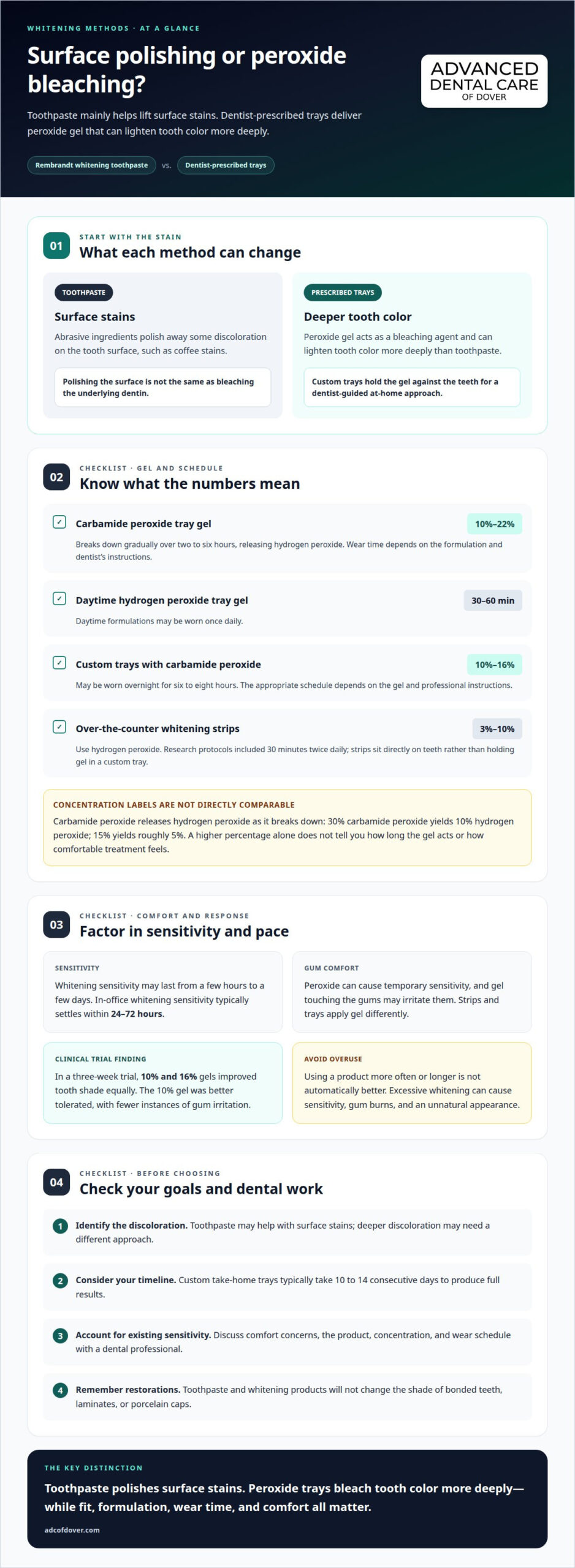
Dentist-prescribed take-home trays use carbamide peroxide at concentrations from 10% to 22%. The gel breaks down over two to six hours, releasing hydrogen peroxide gradually. In a three-week clinical trial, 10% and 16% gels improved tooth shade equally. The 10% gel was better tolerated, with fewer instances of gum irritation, making concentration a comfort consideration as well as a bleaching choice.
Peroxide Concentrations and Bleaching Chemistry
Hydrogen peroxide acts directly as a bleaching agent, while carbamide peroxide releases hydrogen peroxide as it breaks down. For example, 30% carbamide peroxide yields 10% hydrogen peroxide, and 15% carbamide peroxide yields roughly 5%. These figures help explain why the two concentration labels aren’t directly comparable. A higher percentage doesn’t, by itself, describe how long the gel acts or how comfortable treatment feels.
Daytime hydrogen peroxide formulations for trays may be worn for 30 to 60 minutes once daily. Carbamide peroxide gels work more gradually, and custom trays with 10% to 16% gel may be worn overnight for six to eight hours. The appropriate schedule depends on the gel formulation and dentist’s instructions.
Over-the-counter whitening strips use 3% to 10% hydrogen peroxide. Studies have also examined strips with 5% to 6.5% and 9.5% to 14% concentrations, used for 30 minutes twice daily. Strips sit directly on teeth rather than holding gel in a custom tray, so their delivery differs from tray-based peroxide whitening.
| Option | Peroxide details | Typical use in the research |
|---|---|---|
| Carbamide peroxide tray gel | 10% to 22% carbamide peroxide | Gradual release; wear time depends on formulation |
| Daytime tray gel | Hydrogen peroxide formulation | 30 to 60 minutes once daily |
| Whitening strips | 3% to 10% hydrogen peroxide | Study protocols included 30 minutes twice daily |
Compare the pace of whitening, comfort, and whether a custom tray will fit your routine.
How does sensitivity differ across methods?
Sensitivity from whitening varies by product and may last from a few hours to a few days. The method, treatment pace, and your comfort priorities all matter when comparing options.
Sensitivity and Gum Irritation
Whitening toothpaste has much less peroxide than professional products, but its abrasive ingredients target surface stains rather than bleaching deeper tooth color. Peroxide treatments can cause temporary sensitivity, while gel touching the gums may irritate them. In-office whitening sensitivity typically settles within 24 to 72 hours.
If you already have sensitive teeth, make comfort a key part of your decision. Excessive whitening can cause sensitivity, gum burns, and an unnatural appearance, so using a product more often or for longer is not automatically better.
Sensitivity Management
Before choosing peroxide whitening, discuss any existing sensitivity with a dental professional. They can consider the product, concentration, and wear schedule together, rather than treating concentration alone as a measure of comfort. Strips and trays also differ in how they apply gel to teeth and gums.
Calcium phosphate may come up in conversations about sensitivity, but no specific product or result applies to every patient. A dentist can help weigh comfort needs against the desired shade change and timeline.
How long does it take to see results with Rembrandt toothpaste versus dentist trays? Whitening toothpaste may help reduce surface stains, but it is not the same as peroxide bleaching. Custom take-home trays typically take 10 to 14 consecutive days to produce full results.
If your teeth are sensitive, avoid excessive whitening, which can worsen discomfort. Crowns and fillings matter too: Rembrandt toothpaste won’t change the color of bonded teeth, laminates, or porcelain caps, so those restorations may not match newly whitened natural teeth.
For a comfortable choice, weigh your sensitivity, desired pace, and budget together. A professional whitening consultation can help connect those priorities with an appropriate approach.
How does whitening toothpaste work?
Whitening toothpaste mainly removes surface stains, such as discoloration from coffee. It works differently from peroxide bleaching, which targets deeper tooth color. The Rembrandt whitening toothpaste vs dentist professional trays comparison starts with what each method can change.
Surface-Stain Removal
Most whitening toothpastes use abrasive ingredients to remove stains from the tooth surface. This polishing can make teeth look cleaner, but it does not bleach the underlying dentin. A brighter surface is not the same as changing the natural color beneath enamel, so think of toothpaste as an option for surface stains.
Most major-brand whitening toothpastes do not contain peroxide, though some do. Check the active ingredients rather than assuming a whitening label means the product contains bleaching ingredients. This distinction clarifies the Rembrandt whitening toothpaste vs dentist professional trays comparison: one approach may polish away surface stains, while the other uses peroxide to bleach teeth.
Surface and Deeper Stains
Surface stains sit on the outside of teeth, while deeper discoloration lies within them. Toothpaste may help reduce some surface staining, while deeper discoloration may need a different approach. Peroxide treatment works differently, so first consider whether your concern is surface staining or deeper tooth color.
Whitening products will not change the shade of bonded teeth, laminates, or porcelain caps. Rembrandt whitening toothpaste will not whiten these restorations, so natural teeth and veneers may not respond alike.
Research findings show why toothpaste shouldn’t be treated as a substitute for bleaching. In a laboratory study, tested charcoal and regular fluoridated toothpastes produced no significant whitening after 12 weeks of brushing. A randomized clinical trial found blue covarine toothpaste used for two weeks produced color changes similar to conventional toothpaste, but lower than at-home bleaching.
For everyday stain control, rinse your mouth after consuming staining foods or beverages. One suggested routine is to leave whitening toothpaste slurry on teeth for 5 minutes after brushing. Abrasive action isn’t the same as a higher bleaching concentration, so brushing harder isn’t a substitute for peroxide treatment. Charcoal products deserve particular caution: a literature review found only 28% of charcoal toothpastes were low in abrasiveness. Protecting enamel means considering ingredients and abrasive effects, not just whitening claims.
Custom tray fitting and at-home use
A dentist can explain how tray fit, gel application, and wear schedule affect treatment, and distinguish toothpaste for surface stains from peroxide bleaching.
Custom Tray Fitting
Custom take-home trays are made to fit your teeth, unlike whitening strips, which sit directly on tooth surfaces. The American Academy of Cosmetic Dentistry recommends custom-fitted mouth trays under a dentist’s supervision. The fit is one part of the process; the gel’s action and wear schedule also determine how whitening works.
Use schedules vary by formulation. At-home trays may be worn for two to four hours per treatment over several days, or six to seven hours nightly for ten nights. Custom-tray results typically develop over one to two weeks. Follow the dentist’s instructions for the specific gel and its application time.
Safe Use of Toothpaste and Trays
Rembrandt whitening toothpaste addresses surface stains, while professional take-home trays use peroxide gel to bleach teeth. The products serve different purposes and have different application methods: toothpaste removes stains, while tray gel works through peroxide exposure during its prescribed wear schedule.
Follow the toothpaste directions and your dentist’s instructions for tray use. Excessive whitening can cause sensitivity, gum burns, and an unnatural appearance. A dentist can consider sensitivity concerns and explain how the selected gel schedule differs from everyday toothpaste use.
Custom take-home trays typically take 10 to 14 consecutive days to produce full results. A dentist can also explain how visible changes may develop across the treatment period, based on the selected gel and its use schedule.
Discuss custom teeth whitening and at-home tray guidance with a dental professional.
Advanced Dental Care of Dover: Tooth Extractions
Advanced Dental Care of Dover offers teeth whitening and veneers for patients considering professional cosmetic care. A dental visit can help distinguish surface stains from deeper discoloration and account for sensitivity and existing restorations when discussing whitening options.
Tooth extractions address a different dental need and are not a whitening method. If your main concern is tooth shade, focus on cosmetic care. If you are also considering veneers, discuss how restorations may affect your smile’s appearance.
To discuss professional whitening options, make an appointment with Advanced Dental Care of Dover.
Choose a whitening path that fits your smile
Start by identifying what you want to change about your smile: surface brightness, deeper color, or the appearance of existing dental work. This gives your dental conversation a clear focus, especially when weighing Rembrandt whitening toothpaste against dentist-prescribed professional trays. Share any sensitivity concerns or existing restorations so the discussion can address your comfort and priorities.
Advanced Dental Care of Dover also provides emergency dentistry, Invisalign clear aligners, and dental implants. If whitening is your focus, keep the conversation centered on cosmetic options and the result you hope to achieve.
Connect with Advanced Dental Care of Dover to discuss your next step. A thoughtful conversation can help you move forward with greater confidence.
Frequently Asked Questions
Which home teeth whitening products usually provide a bleaching action?
Home products with peroxide, including whitening strips and dentist-prescribed tray gels, bleach teeth. Whitening toothpaste usually focuses on removing surface discoloration. For example, toothpaste may help with coffee stains, while peroxide products act on tooth color. Read the active ingredients and directions to distinguish stain removal from bleaching, especially when comparing products for a specific concern.
How long do results last across methods?
Whitening results vary with the method, touch-ups, and habits that cause new stains. Custom trays with periodic touch-ups may maintain results for one to three years, while in-office results without follow-up are reported to last six to twelve months. Coffee, tea, and tobacco can affect how long teeth look brighter. Consistent oral hygiene and limiting exposure to staining substances can help preserve their appearance.
Are at-home whitening kits as good as professional?
Some at-home peroxide methods can whiten effectively, but the kit’s fit and directions matter. A custom tray is made for your teeth, while a store-bought kit uses a general fit, which can affect how evenly gel contacts teeth. Professional guidance can also account for restorations and sensitivity. Whether one option is “as good” as another depends on your whitening goal and dental needs.
How do the cost of over-the-counter and professional treatments compare?
Over-the-counter products usually involve a smaller initial purchase, while professional treatment includes dental care and, for take-home trays, custom fitting. Total costs can also depend on repeat products or gel refills. Rather than comparing only the first purchase, consider the treatment type, follow-up needs, and how well each option suits your goals.
How can a dentist help you choose between whitening methods?
A dentist can assess the source of discoloration, existing restorations, and sensitivity before discussing a suitable approach. Whitening will not change the shade of porcelain caps or bonded teeth, so those areas may not match newly lightened natural teeth. In Dover and Randolph, discussing your priorities can help clarify whether cosmetic whitening or another approach fits your smile.