
The less visible treatment isn’t automatically the less costly one: Invisalign and braces can cost a similar amount, and the right fit depends on the movements your teeth need. If you’re weighing Invisalign or braces in Dover or Randolph, consider treatment complexity, comfort, daily habits, and the time involved, alongside the overall cost.
It’s understandable to want a clear answer before committing to orthodontic care, especially when the options work differently. This guide compares how each treatment moves teeth, what can affect cost and duration, and what daily wear is like. You’ll also find practical questions to bring to an orthodontic consultation, so you can discuss which approach suits your needs with greater confidence.
Key Takeaways
- Compare the full treatment cost, including what your dental insurance may cover, rather than choosing by the appliance alone.
- Consider your daily routine: removable aligners need consistent wear, while braces stay in place as they move teeth.
- Treatment time depends on the movements needed, so ask how your bite and tooth alignment shape the proposed timeline.
- Think about comfort and cleaning habits, including how removable aligners affect meals and brushing compared with fixed braces.
- At a consultation, ask which option can address your needs, what progress visits involve, and how tooth movement will be monitored.
How much does Invisalign treatment cost?
Orthodontic treatment costs depend on the movements required, treatment duration, appliance type, and location. How much Invisalign costs depends on the individual case, so compare the treatment plans rather than the appliance alone to understand what contributes to the total.
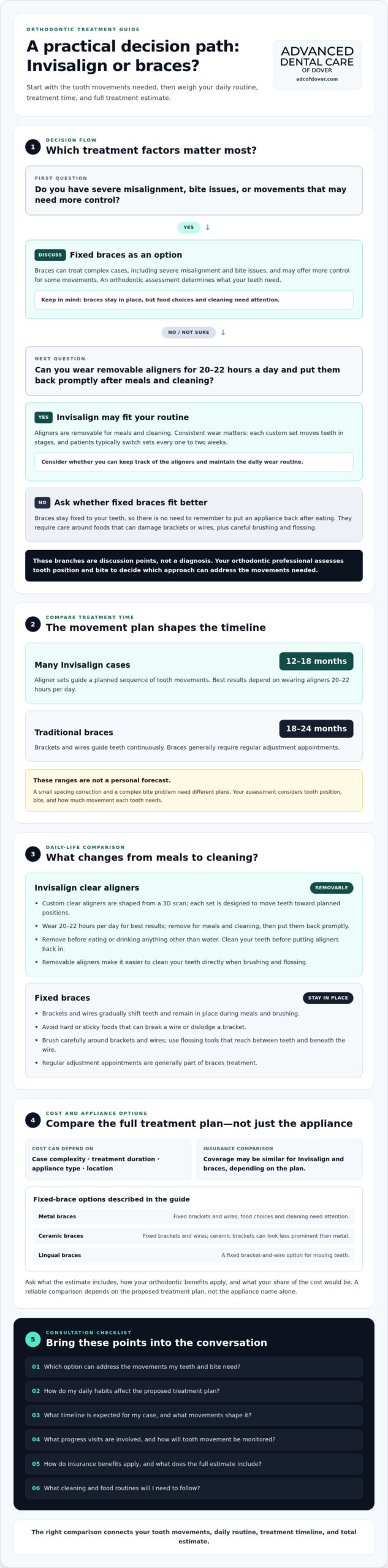
Invisalign aligners are custom-made clear aligners, shaped from a 3D scan of the patient’s mouth. Each set is designed to move teeth toward planned positions. Patients typically switch to another set every one to two weeks. For best results, aligners need to be worn 20-22 hours per day, so they’re removed for meals and cleaning, then put back in promptly.
That routine can affect whether removable aligners suit your daily habits. Adults with busy schedules should consider whether they can keep track of aligners and wear them consistently. Braces stay fixed to the teeth, so there’s no need to remember to put them back after eating. However, fixed braces require care around foods that can damage brackets or wires.
Complexity matters, too. Braces can treat complex cases, including severe misalignment and bite issues, and offer more control for some movements. An Invisalign plan may include attachments to help aligners grip the teeth. A dental professional assesses tooth position and bite to determine which approach can address the movements needed.
| Option | How it works | What can affect cost | Daily consideration |
|---|---|---|---|
| Invisalign clear aligners | Removable custom sets move teeth in stages. | Case complexity, duration, and location. | Wear 20-22 hours per day; remove for meals and cleaning. |
| Metal braces | Fixed brackets and wires gradually shift teeth. | Case complexity, duration, and appliance type. | Fixed in place; food choices and cleaning need attention. |
| Ceramic braces | Brackets and wires provide fixed treatment. | Case complexity, duration, and appliance type. | Fixed in place during meals and brushing. |
| Lingual braces | A bracket-and-wire option for moving teeth. | Case complexity, duration, and appliance type. | Fixed in place throughout treatment. |
Insurance may cover Invisalign in a similar way to braces, depending on the plan. Review how your orthodontic benefits apply to the proposed treatment, including the amount covered, your share of the cost, and what the estimate includes. This gives you a more useful comparison than looking at the appliance name alone.
When deciding whether Invisalign or braces is a better fit, weigh the movements required, your ability to follow the aligner-wear routine, and the overall treatment estimate. Ask how your bite, daily habits, and proposed treatment plan affect the comparison. Discussing these factors helps connect the cost to the care your teeth need.
Treatment duration
Orthodontic treatment length depends on the movements needed, not just the appliance. Many Invisalign cases take about 12 to 18 months, while traditional braces typically take 18 to 24 months. Those ranges aren’t a personal forecast: a small spacing correction and a complex bite problem require different plans. The orthodontic assessment considers tooth position, bite, and how much movement each tooth needs.
For an individual case, the treatment plan maps a sequence of tooth movements. Invisalign patients move through custom aligner sets, while braces use brackets and wires to guide teeth continuously. Consistent aligner wear matters: Invisalign aligners should be worn 20-22 hours per day for best results. A missed routine can interrupt the planned sequence and affect progress.
Cost is another part of the comparison. A reliable average cost for Invisalign versus braces isn’t appropriate here; treatment estimates depend on the case, appliance, duration, and location, and are provided after a quote request. Dental insurance may cover Invisalign similarly to braces.
Oral hygiene also differs during treatment. Removable aligners come out for brushing and flossing, making it easier to clean your teeth directly. Remove them before eating or drinking anything other than water, then clean your teeth before putting them back. With braces, brush carefully around brackets and wires, and use flossing tools that reach between teeth and beneath the wire.
Food choices depend on the appliance. With braces, avoid hard or sticky foods that can break a wire or dislodge a bracket. With Invisalign, remove aligners for meals and drinks other than water. For example, take them out before lunch, store them safely, then brush before putting them back in. These habits make daily care part of the treatment plan.
Choose based on your dental needs and routine. Severe misalignment or bite issues may call for the control fixed braces provide in complex cases. Someone who can wear removable aligners consistently may prefer their flexibility for meals and cleaning. Ask how the proposed plan addresses your bite and expected movements, and what progress visits involve. Braces generally require regular adjustment appointments.
For a clearer comparison, bring your questions about timing, insurance, and hygiene to an orthodontic consultation. You can also explore orthodontic treatment options as you consider which approach fits your dental needs and daily routine.
SmartTrack material and comfort
Invisalign aligners are made from transparent, BPA-free plastic, making them less visible than metal brackets and wires. Their clear appearance may appeal to adults who prefer a less noticeable option at work, in photographs, or in everyday conversations. Braces remain visible, although ceramic brackets can look less prominent than metal ones. Appearance is personal, but it helps to picture each appliance in your daily life.
Comfort can change as teeth respond to treatment. The first three to five days with each new Invisalign tray may feel the most uncomfortable. A fresh set can feel noticeable at first, then become easier to wear as your mouth adjusts. Following the prescribed wear schedule helps each tray work as planned, rather than prolonging the adjustment by wearing it inconsistently.
Braces involve a different adjustment. Their brackets and wires stay attached as teeth move, and parts can rub against the cheeks or lips. A newly placed or adjusted wire may feel unfamiliar during meals or conversation. Invisalign trays have a smooth plastic surface, but a new tray can still feel tight as it begins guiding teeth. Comfort varies from patient to patient with either option.
For example, someone who speaks often at work may value clear aligners’ lower visibility, while another person may prefer not to remove and track trays. Invisalign aligners come out for eating and cleaning, but that flexibility requires a daily routine. Braces stay in place during meals and brushing, so patients need to clean around brackets and wires. These practical differences can affect comfort as much as the material itself.
Small contact points can matter. Invisalign patients may need tooth-colored attachments to help aligners grip and move teeth. These attachments can make the appliance more noticeable up close, even though the trays are clear. Braces use visible brackets to hold the wire, which applies ongoing pressure. The treatment plan, tooth movements, and appliance fit all shape how orthodontic care feels.
When comparing comfort, consider a full day, not just a quick look in the mirror. Picture eating lunch, brushing afterward, speaking in a meeting, and adjusting to a new tray during its first three to five days. Also consider whether fixed brackets or removable aligners better match your habits. Seek professional advice about severe or persistent irritation instead of dismissing it as a routine adjustment.
At an appointment, ask how each option may feel during the first days, what to do if a bracket or tray rubs, and whether your plan includes attachments. These specific questions help you compare appearance and comfort with the movements your teeth need.
Questions to ask at an orthodontic consultation
Choose between Invisalign and braces by matching the appliance to your tooth movements, bite, and daily routine. Ask how each option would straighten your teeth, what appointments involve, and how progress will be measured.
Case Suitability
Suitability is the first comparison: clear aligners are removable and discreet, while braces stay fixed and offer more control in complex cases. Braces can address severe misalignment and bite issues. Invisalign is suited to selected movements, including mild-to-moderate crowding or spacing. Ask which specific movements your plan needs to correct and how the proposed appliance can address them.
Dentist or Orthodontist Guidance
A dental professional evaluates your teeth, bite, and overall oral health before recommending orthodontic treatment. Ask what findings support the recommendation, whether attachments or other steps are part of the plan, and how movement will be tracked. This gives you a reasoned comparison based on your dental needs, not appearance alone.
Make the conversation practical. Describe your work, meals, and comfort with removable appliances. For example, someone who often forgets belongings may find fixed braces simpler to manage, while someone who values a discreet appearance may prefer removable aligners. Then ask how your habits affect the treatment routine and what could interrupt progress.
- Which teeth and bite concerns will the treatment correct?
- Is Invisalign appropriate for my case, or do complex movements favor braces?
- How often will visits take place, and what happens during each checkup?
- What should I do if an aligner is lost or a bracket or wire breaks?
Appointment schedules differ by appliance and plan. Braces patients generally attend adjustment visits every six to eight weeks. Invisalign progress check-ins are also scheduled every six to eight weeks, while patients manage aligner changes at home. Ask whether your plan requires a different schedule and how missed visits affect monitoring.
Routine adjustments and emergency appointments are different. A loose bracket or broken wire can need attention, while a lost aligner raises questions about the next treatment step. Emergency visits occur almost 80% less frequently for Invisalign patients than for patients with braces. Ask whom to contact and what to do before an urgent appointment.
Before leaving, ask the dental professional to explain the recommended option, the movements it can achieve, and how progress will be reviewed. Clear answers about suitability, appointment schedules, and practical challenges make it easier to choose a treatment that fits your dental needs and lifestyle.
How braces move teeth
Traditional braces use brackets and wires bonded to teeth to shift them gradually. Metal brackets hold the arch wire against each tooth, and the wire guides movement over time. Because braces stay fixed, they continue applying force between appointments. The dental professional adjusts the wire as treatment progresses, directing teeth toward the planned alignment.
Imagine a crowded front tooth sitting slightly behind its neighbor. A bracket attached to that tooth connects it to the wire, helping guide it toward the intended position. Other brackets coordinate nearby teeth rather than moving one tooth in isolation. This connected system lets braces address several positions as part of an overall plan.
Braces can also help correct a bite. If upper and lower teeth don’t meet as planned, a dental professional can use the fixed appliance to guide them into a better relationship. Braces can treat complex cases, including severe misalignment and bite issues. Their control can be useful when treatment involves more than closing a small gap.
Invisalign aligners work differently. Each removable, custom-made clear tray is designed to guide teeth through a planned sequence of positions. Patients change aligners as directed, with each new tray continuing the movement. Some patients need tooth-colored attachments to help aligners grip the teeth. Aligners can suit selected mild-to-moderate movements, but they depend on consistent wear.
The difference isn’t simply fixed versus removable. Braces remain in place during meals and brushing, while Invisalign aligners are removed for eating and cleaning. Removable trays can make brushing and flossing easier, but patients need to wear them 20-22 hours per day for best results. Fixed brackets avoid the task of putting an appliance back in, but require careful cleaning around wires.
For a useful comparison, consider the movement itself. A small spacing correction may suit a staged aligner plan, while severe crowding or a complicated bite may call for the control braces provide. The key question is how the appliance will move each tooth, not which option looks simpler. A dental professional can explain the planned positions and why the approach suits your case.
At a consultation, ask how brackets and wires will guide your teeth, what movements the plan targets, and how progress will be reviewed. If removable aligners are being considered, ask how the sequence addresses the same movements. A clear explanation lets you compare the mechanics, daily care, and expected appointments. To discuss Invisalign treatment options, bring your questions about tooth movement to a dental consultation.
Advanced Dental Care of Dover: Emergency dentistry
Advanced Dental Care of Dover can help you take the next step, whether you’re considering clear aligners or need care for a dental emergency during clinic hours. For orthodontic concerns, its Invisalign service provides a way to discuss removable aligners and whether they fit your treatment needs. If a sudden dental problem interrupts your routine, emergency dentistry can address the immediate concern and help you understand what care comes next. The right conversation starts with explaining what you’re experiencing, your dental goals, and any questions about treatment. For support with Invisalign or an urgent dental concern, contact Advanced Dental Care of Dover or visit the website.
Take the next step with confidence
Deciding whether Invisalign or braces fits your life is personal, and should be grounded in your dental needs and the care routine you can maintain. Bring your questions and priorities to a conversation with a dental professional. A clear discussion can turn a difficult comparison into a manageable plan that feels right for you.
Advanced Dental Care of Dover offers Invisalign clear aligners and emergency dentistry, as well as dental implants for tooth replacement. If you’re ready to discuss orthodontic options or have a dental concern that needs attention, make an appointment to explore an appropriate next step.
Contact Advanced Dental Care of Dover to start a conversation about your care. You deserve to feel informed and comfortable as you move forward.
Frequently Asked Questions
Invisalign vs braces: What’s the difference?
Invisalign moves teeth with removable clear trays, while braces use brackets and wires attached to teeth. The practical difference shows up in everyday routines: aligners come out for meals and cleaning, while braces stay in place. For example, someone who wants to eat without an appliance may appreciate removable trays, while someone who prefers not to manage a removable device may prefer fixed braces.
Do you really have to wear Invisalign 22 hours a day?
Invisalign aligners should be worn 20-22 hours per day for best results, so 22 hours is the top end of the recommended daily range, not a separate target for everyone. Remove them for meals, drinks other than water, and cleaning, then put them back in. If a busy day makes consistent wear difficult, discuss how that routine fits your treatment plan.
What are traditional braces?
Traditional braces are fixed orthodontic appliances made with brackets and wires bonded to teeth. The brackets hold the wire, which guides teeth toward planned positions as treatment progresses. Because the appliance stays in place, patients clean around brackets and wires rather than removing it to brush. Hard or sticky foods can damage a bracket or wire, so food choices require care during treatment.
What is the hardest week of Invisalign?
There isn’t one hardest week for every patient. The first three to five days with each new tray may feel most uncomfortable as teeth adjust to its pressure. For example, a fresh aligner can feel tight when first inserted, then become more familiar. Following the prescribed change schedule and wear routine helps keep treatment on track. Ask a dental professional about discomfort that concerns you.
Which One is More Cost-Effective for Adults?
Neither option is automatically more cost-effective for adults. Invisalign can cost a similar amount to braces, and the estimate depends on the movements required, treatment duration, appliance, and location. Compare what each proposed plan includes, how insurance benefits apply, and whether removable aligners fit your routine. An option that works with your habits may be easier to follow throughout treatment.
Which is the Best Treatment Option?
The best option is the one suited to your teeth, bite, and ability to follow its care routine. Braces can treat complex alignment and bite issues, while removable aligners suit selected cases and require consistent wear. For example, consider whether you can remove, store, and replace trays throughout a workday. A dental professional can assess your bite and oral health before recommending a plan.
Will insurance cover Invisalign?
Some dental insurance plans cover Invisalign similarly to braces, but benefits depend on the plan’s orthodontic coverage and limits. Review how your plan applies its benefits to the proposed treatment, including any age rules or lifetime maximums. Coverage can reduce out-of-pocket expenses, but it doesn’t determine which appliance is appropriate.
How do Invisalign and traditional braces compare in effectiveness?
Both approaches can move teeth, but they offer different levels of control and require different routines. Braces can provide more control in complex cases, including severe misalignment and bite issues. Invisalign uses removable trays to guide selected movements, and some patients need attachments to help trays grip their teeth. The key comparison is whether the planned appliance can achieve the movements your bite and alignment require.