
A removable denture can still gain support from implants, so the dental implant vs. denture choice isn’t always simply fixed teeth or a removable appliance. Implants are placed in the jawbone and can support a crown, bridge, or denture; traditional dentures rest on the gums and can be taken out. The right fit depends on your oral health, the number of teeth being replaced, and how you want your replacement teeth to feel and be cared for.
When comparing dental implant vs denture options, it’s natural to weigh comfort and stability alongside treatment time and upkeep. This guide explains how implants, traditional dentures, and implant-supported dentures work, then compares their stability and maintenance in everyday life.
You’ll also learn what can affect suitability, including jawbone health and gum condition, and why implants may take several months to integrate with the jawbone before final teeth can be placed. With a clearer picture of the trade-offs, you can approach the decision feeling more informed and at ease.
Key Takeaways
- Compare the options by how they’re supported: implants anchor in the jawbone, while traditional dentures rest on the gums.
- Allow for a longer treatment timeline with implants, since they may need several months to integrate with the jawbone before final teeth are placed.
- Consider how each option feels during meals and conversation: implant-supported dentures are anchored for added stability, while traditional dentures can shift if the fit changes.
- Plan for ongoing care. Removable dentures need regular cleaning and may require adjustments or replacement as the mouth changes.
- Use your gum health, jawbone condition, and tooth-replacement needs to guide the choice, rather than focusing on appearance alone.
Dental Implants or Dentures: Which Is Right for Your Smile?
Implants and dentures differ in initial expense, treatment time, and future upkeep. Implants may take several months to integrate with the jawbone before final teeth are placed, while dentures can usually be fitted without that healing stage.
Upfront and Long-Term Costs
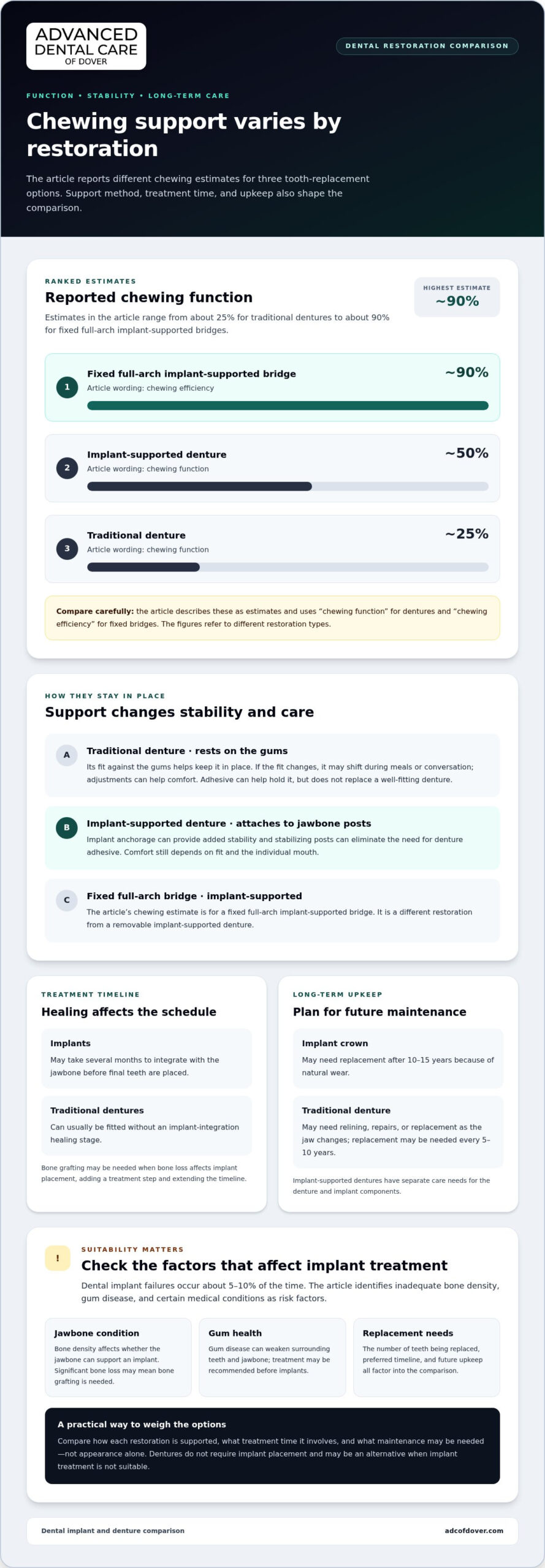
Dentures generally cost less upfront than implants, which typically require a higher initial investment. Compare the full treatment plan, including replacement teeth, any preparatory procedures, and follow-up adjustments. Bone grafting may be needed when bone loss affects implant placement, adding a treatment step and extending the timeline. Implant crowns may need replacement after ten to fifteen years because of natural wear; dentures may need relining, repairs, or replacement as the jaw changes.
For long-term budgeting, consider how often each option may need attention, not just its initial cost. Traditional dentures may need replacement every 5-10 years. Financing terms vary, so compare the payment schedule and what it covers alongside the planned care.
Insurance Coverage and Limits
Dental insurance may contribute toward implants or dentures, but coverage depends on the plan’s annual maximum, exclusions, and treatment rules. There is no single coverage limit across U.S. plans. Review how your plan classifies each treatment and whether related procedures, such as bone grafting, count toward the same limit.
For example, a plan may classify a denture differently from an implant-supported replacement. The annual maximum and covered services determine the plan’s contribution, while your remaining balance depends on the treatment selected.
Implant Success Rates and Risks
Dental implant failures occur about 5 to 10 percent of the time. Risk factors include inadequate bone density, gum disease, and certain medical conditions. These factors can affect whether the jawbone supports an implant and whether additional procedures are needed before placement.
Significant bone loss may mean bone grafting is needed before implant treatment, extending the timeline. Gum disease can weaken the surrounding teeth and jawbone, so treatment may be recommended before implants. Dentures don’t require implant placement and may be an alternative when implant treatment is not suitable.
| Option | Upfront cost | Healing and timeline | Long-term upkeep |
|---|---|---|---|
| Dental implant | Typically higher than dentures | Several months for jawbone integration before final teeth | A crown may need replacement after ten to fifteen years |
| Traditional denture | Generally lower than implants | No implant integration period | May need relining, repairs, or replacement every 5-10 years |
| Implant-supported denture | Includes implant treatment | Implants need time to integrate with the jawbone | Denture and implant components have separate care needs |
Weigh bone density, gum health, and the number of teeth being replaced against your preferred timeline and upkeep. For example, someone prioritizing lower initial expense may favor dentures, while someone seeking a jawbone-anchored option may consider implants.
Are traditional dentures as stable as implant-supported dentures?
Traditional dentures rest on the gums, while implant-supported dentures attach to posts placed in the jawbone. This difference can affect stability during eating and speaking, as well as how often adjustments are needed if a denture shifts.
Comfort, Fit, and Stability
A traditional denture relies on its fit against the gums to stay in place. If that fit changes, the appliance may shift during a meal or conversation, making adjustments important for comfort. Adhesive can help hold it in place, but it doesn’t replace the need for a well-fitting denture.
Implant-supported dentures connect to implants in the jaw, giving the appliance anchorage that gum-supported dentures lack. Stabilizing posts can eliminate the need for denture adhesive. This may make the appliance feel more secure, though comfort still depends on fit and the individual mouth.
Stability matters in everyday moments, not just during meals. A denture that moves while speaking may make some words harder to pronounce, while movement during eating can interrupt chewing. A secure fit can help you focus on the conversation or meal rather than repositioning the appliance.
Appearance matters, but it doesn’t tell the whole story. Both options replace missing teeth; the practical difference is how they’re held in place. Someone whose traditional denture shifts may value anchorage, while another person may prefer an appliance that can be removed without implant support.
Chewing Function and Gum Irritation
Chewing estimates differ by restoration type: traditional dentures provide about 25% chewing function, implant-supported dentures about 50%, and fixed full-arch implant-supported bridges about 90% chewing efficiency. These figures describe different options, so compare like with like when considering how each may support eating.
Traditional dentures can rub or irritate the gums, particularly when they slip or no longer fit properly. Implant-supported dentures are anchored rather than resting only on the gums, which can reduce movement and the need for adhesive. Their stability may make chewing feel more controlled, though the denture still needs a comfortable fit.
Consider the activities that matter most to you: eating a range of foods, speaking comfortably, and managing daily care. A loose fit, gum irritation, or repeated repositioning can indicate that an adjustment may help. The preferred option depends on whether removable convenience or added anchorage better suits your needs.
| Feature | Traditional dentures | Implant-supported dentures |
|---|---|---|
| Support | Rest on the gums | Anchored to implants in the jaw |
| Adhesive | May be used to help hold the denture | Stabilizing posts can eliminate adhesive |
| Estimated chewing function | About 25% | About 50% |
If stability during eating or speaking is a concern, explore tooth-replacement options as part of your decision.
Denture stability and maintenance
Daily care depends on whether replacement teeth are removable or anchored in the jaw. Traditional dentures are removable for cleaning and sleeping, while implant-supported dentures may be fixed or removable. When comparing options, consider the routine care each requires and how changes in the jaw can affect fit over time.
Remove a removable denture for cleaning and sleeping. This makes it easier to clean the appliance separately from your mouth. Traditional dentures and removable implant overdentures come out at night. A fixed implant-supported restoration stays in place, so its daily care differs from that of a removable appliance.
Fit can change as the jawbone changes after tooth loss. Dentures may need relining, adjustments, repairs, or replacement as their fit and condition change. For example, a denture that once felt secure may shift as the supporting gums and bone change. Paying attention to fit helps you notice when an appliance may need adjustment.
The American Dental Association recommends replacing dentures every 5-7 years. With proper care, dentures can last up to 7 years, but wear and changes in the mouth can affect their usefulness. Those timelines make ongoing maintenance part of the decision, not just the initial choice between replacement options.
Implant-supported dentures are anchored to implants in the jaw and can last decades with proper care. That does not make every part of the restoration permanent: the denture and its supporting components have their own care needs. A removable implant overdenture still comes out at night, while a fixed version remains in place.
Care for dental implants includes brushing at least twice a day with a soft-bristle brush. This routine supports oral health around the implant and replacement tooth. For a removable denture, cleaning the appliance outside the mouth is part of daily care. The practical difference is whether your routine includes removing the replacement teeth.
Appearance can change as a denture wears or its fit shifts. A loose appliance may move during speaking or eating, affecting how it feels and looks in everyday situations. Implants stimulate the jawbone, while dentures do not prevent natural bone loss after tooth loss. This distinction may matter when weighing long-term oral health alongside appearance.
As a simple maintenance guide, consider three points: whether the appliance is removable, whether its fit has changed, and whether it needs adjustment or replacement. Dentures are removable for cleaning, while fixed implant-supported teeth stay anchored. Matching your care routine to the restoration helps you plan for daily upkeep and future maintenance.
How dental implants and dentures work
Dental implants and dentures replace missing teeth in different ways. An implant begins with a small post placed surgically in the jawbone, while a denture rests on the gums. This difference in support explains why one option is anchored and the other can be removable.
A dental implant acts like an artificial tooth root. It is typically made from titanium and placed in the jawbone, where it integrates with the bone. Once healing is complete, the implant can support a crown, a bridge, or a full arch of replacement teeth. The final restoration depends on how many teeth need replacing and the planned design.
For one missing tooth, an implant can hold a single crown. If several teeth are missing, implants may support a bridge, replacing a row of teeth without a separate implant for each one. Implants can also support a full arch. In each case, the implant provides the foundation, while the visible replacement teeth restore the chewing surface.
Traditional dentures work without implant posts. A partial denture replaces several missing teeth and fits around remaining natural teeth. A full denture replaces an entire upper or lower arch. Both types rest on the gums and can be removed for cleaning. Their fit and shape help keep them in place during eating and speaking.
Implant-supported dentures combine these approaches. For some people with no natural teeth, two to four dental implants can stabilize a removable denture. The denture attaches to the implants for added support, then comes out for cleaning. Other implant-supported dentures are fixed in place. The key difference is whether the wearer can remove the restoration.
The treatment sequence also differs. With an implant, the post is placed first, then the jawbone needs time to integrate with it before the final crown, bridge, or denture is attached. This process can take several months. A traditional denture doesn’t require an implant integration period, though its fit may need adjustments as the mouth changes.
Implants also interact with the jawbone differently. Chewing forces pass through an implant into the bone, providing stimulation beneath the replacement tooth. After tooth loss, the bone beneath the gap can shrink over time because it no longer receives the same stimulation. Dentures replace visible teeth but don’t prevent this natural bone loss.
Think of the choices as three support styles: a single implant with a crown, a removable denture resting on the gums, or a denture anchored to implants. Start your comparison with the number of missing teeth, the condition of the jawbone, and whether you prefer fixed or removable teeth.
What is the difference between dental implants and dentures?
The main difference is how each replacement tooth is supported. A dental implant is placed in the jawbone and supports a crown, bridge, or full arch. A denture sits on the gums and can replace several teeth or an entire arch. That choice affects daily care, bone support, and whether your replacement teeth are removable.
An implant replaces the missing tooth’s root as well as its visible crown. As it integrates with the jawbone, it can help maintain bone structure by transmitting chewing forces. Tooth loss can cause the bone beneath a gap to shrink over time because it no longer receives that stimulation. Dentures restore visible teeth but don’t prevent this natural bone loss.
Consider replacing missing teeth in Dover, NJ. A single implant can support one crown, while a bridge can replace several teeth. Partial dentures also replace several teeth, fitting around remaining natural teeth. A full denture replaces an entire arch. For someone missing all teeth, an implant-supported denture can combine a removable appliance with jawbone anchorage.
The options also differ in expected service life and upkeep. Dental implants could provide 20 or more years of service. Dentures last an average of five to ten years, and their fit may change as the jaw changes. An implant is a non-removable tooth-replacement solution, while traditional dentures come out for cleaning. Both need consistent care to support oral health.
Suitability depends on more than the size of the gap. Bone health, gum condition, and overall dental health help determine whether the jaw can support implants. Gum disease can weaken surrounding teeth and bone, so treatment may come before implant placement. Certain medical conditions or inadequate bone density can also affect implant treatment. Dentures may suit patients whose treatment plan doesn’t involve implants.
- One missing tooth: Compare an implant-supported crown with a partial denture.
- Several missing teeth: Consider a bridge, implants, or a partial denture.
- An entire arch: Compare a full denture with an implant-supported restoration.
- Changing bone or gum health: Include those conditions in the treatment decision.
Use this guide to narrow your priorities: fixed teeth, a removable appliance, or support that helps maintain jawbone structure. The dental implant versus denture decision should also reflect how many teeth need replacing and the condition of your gums and bone. Explore dental implant options as you consider which approach fits your needs.
Advanced Dental Care of Dover: Emergency dentistry
Advanced Dental Care of Dover offers dental implants and emergency dentistry for different dental needs. If you’re weighing an implant against a removable denture, discuss your missing teeth, gum health, and jawbone to clarify the options. For urgent dental concerns, the practice offers emergency dentistry during clinic hours. Tooth extractions are also available when a tooth needs removal.
Dental implant treatment and emergency care address different situations, so the right next step depends on what’s happening in your mouth. You can bring your questions about stability, healing, and daily care into a discussion about replacement options.
Contact Advanced Dental Care of Dover to discuss your dental needs, or visit adcofdover.com.
Take the Next Step Toward a Comfortable Smile
Choosing between a dental implant and a denture is personal, and your priorities can guide a useful conversation. Before deciding, consider what matters most in daily life: how you want replacement teeth to feel, the care routine you can maintain, and what you hope to preserve for your oral health. Write down questions about how your dental health may affect your treatment options.
A dental professional can consider your priorities alongside your gums, jawbone, and overall oral health. Advanced Dental Care of Dover offers dental implants, and a discussion can help you understand how that option relates to your needs. Your individual dental circumstances guide which approach makes sense.
When you’re ready to talk through your next step, contact Advanced Dental Care of Dover. You deserve clear guidance and a care plan that feels right for you.
Frequently Asked Questions
Which Option Is Right for You?
The right choice depends on your oral health, pattern of tooth loss, and preferred daily routine. Replacing one tooth differs from restoring a full arch, and the health of nearby teeth can influence your options. Consider whether you prefer a removable appliance or a fixed replacement, then discuss how gum condition and jawbone support affect your choices. A dental assessment can help narrow the options around your priorities.
Are Dental Implants Worth the Cost?
Implants may be worth considering if fixed replacement teeth and jawbone support matter to you. Their value isn’t measured only by the initial expense: consider treatment stages, future care, and how the replacement fits your eating and speaking habits. Dentures may suit someone who values removability or a simpler treatment path. Weigh these practical priorities alongside your oral health and long-term plans.
How does gum disease affect tooth loss and the choice of dentures or implants?
Gum disease can weaken the tissues and jawbone that support teeth, which can affect implant suitability. A dentist may recommend treating active gum disease before placing implants. Gum health also matters for dentures: irritated or changing gums can affect how an appliance sits and feels. For example, a patient with gum inflammation may need care for that condition before choosing a tooth-replacement approach.
What Are Dentures?
Dentures are removable appliances that replace missing teeth. A partial denture fills gaps while some natural teeth remain; a full denture replaces the teeth in an entire arch. They’re made to fit the mouth and restore the appearance of missing teeth. Because the mouth can change after tooth loss, a denture’s fit may need attention over time. Dentures can be removed for cleaning.
What are the benefits of consulting an experienced dentist for tooth replacement options?
A dentist can assess your gums, jawbone, remaining teeth, and overall oral health before comparing treatment choices. This connects the options to your pattern of tooth loss, rather than relying on appearance alone. For people in Dover and Randolph, Advanced Dental Care of Dover offers dental implants and dentures. An individualized discussion can help clarify which factors matter in your situation.
How much do dental implants and dentures cost in the United States?
The total depends on the number of teeth being replaced, the type of restoration, and any preparatory treatment needed. Replacing one tooth and restoring a full arch involve different components and treatment steps. Insurance terms can also affect your out-of-pocket amount. Compare the complete treatment plan, including follow-up care, rather than judging affordability by the appliance alone.
How long do dental implants and dentures last?
Dental implants could provide 20 or more years of service, while dentures last an average of five to ten years. Those timelines refer to different types of restorations, and individual components may wear at different rates. Care routines, changes in the mouth, and the condition of the restoration all affect how long it remains useful. Regular dental follow-up helps identify fit or wear issues.
What are the advantages and disadvantages of implants versus dentures for eating and speaking?
Implant-supported teeth stay anchored, which can help limit movement during meals or conversation. Traditional dentures can shift if their fit changes, although their removable design makes cleaning straightforward. A new appliance may take time to get used to when speaking and chewing. Consider the foods you commonly eat and whether you value fixed support or removability when comparing options.