
For complex cases, dentist-supervised clear aligners are generally a better fit because professional evaluation and monitoring can help address bite changes and more involved tooth movements. In the Byte aligners vs dentist clear aligners comparison, at-home treatment is more suited to mild cases, while bite correction or complex alignment may call for closer oversight.
It’s understandable to be drawn to the convenience of treatment at home, especially if you’re looking for a simpler path to a straighter smile. The key question is whether treatment accounts for your bite, gum health, and the movements your teeth need, not just how the aligners are delivered.
This guide explains how professional evaluation, treatment monitoring, and complex tooth movements differ between the two approaches. You’ll also find a practical way to compare options and identify what to consider before starting.
Key Takeaways
- At-home aligners may suit mild alignment needs, while complex tooth movements and bite concerns generally call for dentist-supervised care.
- Learn how an in-person evaluation can account for your bite, gum health, and overall dental health before treatment begins.
- See why progress reviews matter, including how they help identify when teeth aren’t tracking as planned or a treatment adjustment may be needed.
- Understand the concerns reported with direct-to-consumer aligners and why diagnosis and follow-up are important parts of treatment.
- Use the decision guide to weigh your treatment needs and consider whether Invisalign with professional oversight may be a better fit.
Invisalign personalization and orthodontist oversight
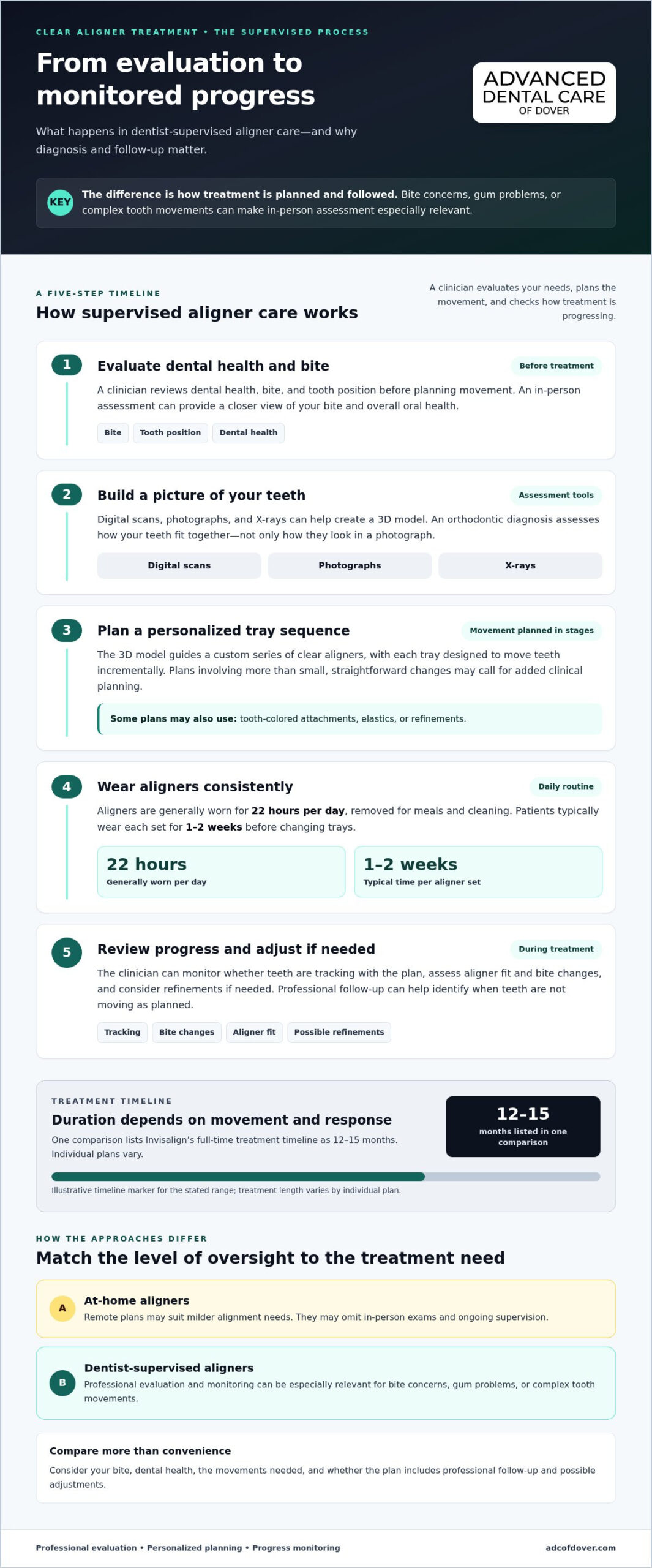
Invisalign treatment starts with a professional evaluation, not simply a tray order. The clinician reviews dental health, bite, and tooth position before planning movement. Digital scans, photographs, and X-rays can help build a 3D model of your teeth. That model guides a personalized series of clear aligners, with each tray designed to move teeth incrementally.
During treatment, patients typically wear each aligner set for 1-2 weeks before changing trays. Aligners are generally worn for 22 hours per day, removed for meals and cleaning. Your clinician can monitor whether teeth are tracking with the plan and consider refinements or tools such as tooth-colored attachments and elastics. These steps matter when the plan involves more than small, straightforward changes.
At-home brands such as Byte and SmileDirect are associated with direct-to-consumer aligner treatment, while Invisalign treatment includes professional evaluation and monitoring. The difference is not simply the brand name: it’s how treatment is planned and followed. Remote aligner care may suit milder cases, but a bite concern, gum problem, or complex movement can make in-person assessment especially relevant. SmileDirect’s name also appears in comparisons, but a brand mention alone doesn’t establish current treatment availability.
Clear aligners are one alternative to braces, not the only path to straighter teeth. Braces use brackets and wires, while clear aligners are removable trays. The right approach depends on the movements needed, your bite, and whether you can wear removable trays consistently. For example, someone seeking a minor spacing change may value the convenience of removable aligners, while more involved correction may require closer clinical planning.
Treatment duration depends on the planned movement and how teeth respond. One comparison lists Invisalign’s full-time treatment timeline as 12-15 months, though individual plans vary. Costs also depend on the case, treatment length, and level of care; the price is given after a quote request. Avoid comparing options on convenience alone: account for the monitoring and possible adjustments your treatment may need.
| Option | Personalization | Oversight | Best consideration |
|---|---|---|---|
| Byte or SmileDirect at-home aligners | Remote aligner plan | May omit in-person exams and ongoing supervision | Milder alignment needs |
| Invisalign | Professional evaluation and custom tray sequence | In-person monitoring and possible refinements | Plans needing individualized oversight |
| Traditional braces | Brackets and wires planned for the teeth | Care is provided through clinical visits | Cases where removable trays are not the preferred approach |
Choose an approach based on your bite, dental health, and need for professional follow-up, rather than convenience alone.
Which clear aligner brand is best?
No single aligner brand is right for every smile. Compare the diagnosis, supervision, and treatment adjustments each approach includes, especially if your orthodontic concerns go beyond mild alignment.
Orthodontist Diagnosis and Supervision
An orthodontic diagnosis assesses how your teeth fit together, not just how they look in a photograph. A professional evaluation may include digital scans, photos, X-rays, bite analysis, and a review of your dental health. These steps can help identify cavities, gum issues, bone loss, or jaw-related problems. Compared with a remote screening, an in-person assessment gives a closer view of your bite and overall oral health before tooth movement begins.
Supervision for Complex Treatment
Treatment complexity affects how much oversight may be useful. Mild spacing may call for a simpler plan, while bite correction or involved alignment can require staged movements, attachments, elastics, or refinements. Professional supervision allows the plan to respond as your teeth move. Remote aligner treatment is better suited to very mild cases and may be unsuitable when treatment requires bite correction, root movement, or closer clinical guidance.
Dentist-Supervised Clear Aligners
Dentist-supervised clear aligner treatment combines custom trays with professional diagnosis and follow-up. The dentist evaluates your dental health and bite, then monitors whether your teeth follow the planned movements. This differs from mail-order care, which may omit in-person exams, X-rays, and ongoing supervision. For example, someone with crowded teeth and a bite concern can have both assessed together, rather than planning around tooth appearance alone.
Concerns About Results and Dentist Oversight
It’s natural to wonder whether aligners will move your teeth as planned. Dentist oversight provides opportunities to assess progress, bite changes, gum health, and aligner fit during treatment. If your teeth aren’t following the plan, professional monitoring can help identify the issue and whether refinements may be needed. With limited in-person follow-up, changes in your bite or oral health can be harder to assess directly.
Use these questions to compare Byte and dentist-supervised options:
- Does the treatment begin with an in-person dental-health and bite evaluation?
- How will progress and tooth tracking be monitored?
- Does the plan account for bite correction or complex movement?
For dentist-supervised Invisalign care, explore Invisalign clear aligner treatment as one option to discuss in relation to those criteria.
Reported adverse events with direct-to-consumer aligners
Reports of problems help explain why diagnosis and follow-up matter in aligner treatment. They don’t mean every patient will experience a complication, but they highlight issues to discuss before choosing remote care. Ask how tooth position is assessed, what records are reviewed, and how concerns are handled during treatment.
One study recorded around 651 issues associated with sequential aligners. Around 30% involved orofacial pain, around 26% involved periodontal sequelae, and around 41% involved bite problems. These figures describe reported issues, not the likelihood that an individual patient will experience them. They also show why a plan should consider more than whether teeth appear crowded or spaced.
Separately, injury accounted for 87% of reported adverse events involving direct-to-consumer aligners. That figure describes the reported events, not the share of all patients treated. If pain, gum changes, or a new bite problem develops, the practical concern is whether a qualified professional can assess it and adjust the treatment plan. Timely attention can help identify what is happening rather than continuing trays without review.
Remote treatment may use impressions or digital scans to map tooth position, but records alone don’t replace a full dental-health assessment. Before treatment, a consultation can clarify whether the plan includes an in-person exam, X-rays, and ongoing supervision. These steps are especially relevant if cavities, gum problems, bone loss, or bite concerns could affect tooth movement. Wearing aligners as directed is important, but it cannot make up for a plan that overlooks oral health.
Compare aligner brands by their care model, not just their name. Byte is associated with direct-to-consumer treatment, while Invisalign and ClearCorrect are doctor-directed systems. A doctor-directed approach includes professional assessment and monitoring; remote treatment may omit in-person exams or ongoing supervision. These differences affect how concerns can be evaluated during treatment. A brand name alone doesn’t tell you which movements a plan can address or how follow-up works.
Use a consultation to compare the details that shape safety and support:
- Which dental records are reviewed, such as impressions, scans, photographs, or X-rays?
- Who evaluates bite position and gum health before treatment?
- How can you report pain, loose tracking, or a bite change while wearing trays?
- What happens if teeth don’t follow the planned movement?
The answers can help you distinguish convenient remote access from treatment that includes direct professional oversight.
Treatment monitoring and progress reviews
Byte treatment is managed through a remote aligner process, which may omit in-person exams, X-rays, and ongoing professional supervision. Dentist-supervised care can include a dental-health review and X-rays, with monitoring of tooth movement and bite changes.
Progress reviews help determine whether each stage matches the treatment plan. A clinician can assess aligner fit, gum health, bone support, oral hygiene, and changes in your bite. These checks matter because teeth may move differently from what a digital plan predicts. If an aligner no longer fits as expected, a review can help determine whether to pause before the next tray or refine the plan.
- Tooth movement: Compare current tooth positions with the intended movements.
- Aligner tracking: Check that trays fit closely and teeth are following the planned sequence.
- Bite changes: Review how upper and lower teeth meet during treatment.
- Gum health and bone support: Assess oral tissues as teeth move.
- Oral hygiene: Check that cleaning remains effective around removable trays.
- Refinements: Decide whether additional aligners are needed to complete planned movements.
Clear aligner treatment typically follows a step-by-step process: an evaluation informs the plan, a series of trays moves teeth gradually, and progress reviews guide adjustments. Patients wear each set for the prescribed stage before moving to the next. For example, crowded teeth may need a different sequence from gaps, even when both patients use removable aligners. Good support also gives you a clear way to raise concerns about tray fit, discomfort, or a bite that feels different.
Aligners can address concerns such as overbite, underbite, crossbite, gaps, and crowded teeth. Each requires different movements, so the plan and progress checks should reflect the specific concern. For example, closing gaps requires more than checking that trays still fit; the planned spaces need to close in the intended order.
Most patients wear clear aligners for an average of 9-15 months. The finish depends on the planned movements, how consistently trays are worn, and whether refinements are needed. That timeline is a broad average, not a schedule for every smile. A treatment plan with bite correction or several types of movement can require a different sequence from a plan focused on one area.
If you’re comparing remote care with dentist-supervised Invisalign, ask how the process handles progress reviews, bite changes, and refinements. Clear answers can help you understand what support is included and how concerns are addressed before treatment ends.
Bite correction and complex tooth movements
Bite correction depends on how your upper and lower teeth meet, not just whether visible teeth look straight. The movements needed help distinguish a mild alignment plan from more involved orthodontic treatment.
Patient reports about Byte results, treatment time, and customer service vary. A review describes one person’s experience; case complexity, consistent aligner wear, and clinical follow-up all shape an individual treatment journey.
Treatment Options and Case Complexity
Clear aligners can address overbite, underbite, crossbite, open bite, gaps, and crowded teeth. These concerns require different movements, so a plan for closing a gap isn’t automatically suited to correcting how the jaws meet. Moderate or complex cases may need staged movements, attachments, elastics, and refinements. These tools help a supervised plan guide teeth through specific steps.
Remote aligner treatment may suit very mild cases, but can be unsuitable when treatment requires bite correction, attachments, root movement, or complex alignment. For example, a crossbite may need more than straightening the front teeth. A professional evaluation considers your bite and oral health before selecting a movement plan, helping distinguish a cosmetic change from a functional correction.
Reported Byte Results and Treatment Time
Patient accounts of Byte results describe individual experiences, not a reliable prediction for another person’s smile. Treatment time also depends on the planned movements, aligner wear, and whether teeth track as intended. Rather than relying on one reported finish date, consider what the plan is designed to achieve and how progress will be reviewed.
Customer-service feedback concerns communication and support, while clinical results concern tooth movement and bite position. They are different measures. For a complex case, consider whether support includes professional assessment and a way to respond if aligners stop fitting or your bite changes. A convenient remote process alone doesn’t show whether it can manage those treatment needs.
Invisalign treatment may use attachments, elastics, staged movements, and refinements for moderate or complex orthodontic problems. The plan can address overbite, crossbite, or open bite, but the required movement shapes which tools are appropriate. Invisalign arch-expansion accuracy is around 73%, and molar-rotation accuracy is 87%. These figures describe specific movements, not a guarantee that every complex case will finish as planned.
Traditional braces are another option if removable trays aren’t your preference. The decision depends on your bite, the direction of tooth movement, and the support needed during treatment. Ask how the proposed plan addresses each concern, such as crowding and crossbite together, rather than focusing only on straighter teeth.
If you’re weighing treatment approaches, explore a professional review of aligner options and the movements your bite may need.
Advanced Dental Care of Dover: Emergency dentistry
Advanced Dental Care of Dover offers emergency dentistry for dental problems needing prompt attention during clinic hours, as well as Invisalign clear aligners for patients considering dentist-supervised treatment. If tooth pain, damage, or another urgent concern arises while you’re wearing aligners, the clinic can help address the dental issue. Emergency dentistry and aligner treatment serve different needs: one addresses urgent dental concerns, while Invisalign supports planned tooth alignment.
If you’re weighing at-home aligners against dentist-supervised care, Invisalign is a clear aligner option to discuss as part of your dental treatment. Address dental concerns alongside decisions about continuing aligner wear, especially when pain or damage affects your comfort.
For a welcoming next step, contact Advanced Dental Care of Dover or visit adcofdover.com.
Choose a next step that fits your smile
Your next step can be a conversation about more than straightening. Consider what you want to change, any bite or dental concerns you’ve noticed, and what support would help you feel comfortable during treatment. If you have existing dental work or missing teeth, mention that so it can be considered alongside your alignment goals.
Choosing between Byte aligners and dentist-supervised clear aligners comes down to the care and oversight your needs call for. Advanced Dental Care of Dover offers Invisalign clear aligners, emergency dentistry, and dental implants, so you can discuss aligner care in the context of your broader dental needs.
Bring your questions, including what treatment involves and how progress will be followed. A thoughtful conversation can help you understand your options and choose a path that feels right for your smile. Contact Advanced Dental Care of Dover to take that next step with a caring team.
Frequently Asked Questions
Which One Is Better for Complex Cases?
Dentist-supervised clear aligners are generally a stronger fit for complex cases because an in-person clinician can assess and monitor bite changes. In the Byte aligners vs dentist clear aligners comparison, consider whether your plan needs attachments, elastics, or staged movements. For readers in Dover and Randolph, Invisalign is a dentist-supervised option to discuss when tooth position and bite concerns need to be considered together.
Which One Is Better for Mild Cases?
At-home aligners may suit mild cases involving limited tooth movement, such as a small gap or minor crowding. The key question is whether the concern is limited to alignment or also involves your bite, gums, or dental health. For example, a tooth that looks slightly out of line may also affect how your teeth meet, so appearance alone can’t establish whether remote treatment is suitable.
How often do dentist-supervised clear aligner patients have in-office visits?
There isn’t one visit schedule for every patient; appointments are arranged around the treatment plan and progress checks. A review may assess whether trays fit, teeth are moving as planned, your bite is changing, and your gums remain healthy. Ask about expected check-in points before treatment starts, and contact the dental team sooner if an aligner stops fitting or your bite feels different.
What are the risks and side effects of at-home clear aligners versus dentist-supervised treatment?
Both approaches can involve discomfort, but at-home treatment may lack in-person exams and ongoing professional monitoring. Without a thorough assessment, tooth movement can be problematic for someone with cavities, gum issues, bone loss, bite concerns, or jaw-related concerns. Dentist supervision doesn’t remove every treatment risk; it provides opportunities to assess changes and respond if pain, gum irritation, or a new bite problem develops.
How much do Byte aligners cost compared with Invisalign or other in-office clear aligners?
Byte aligners typically feature a lower upfront cost than in-office treatments like Invisalign, as they eliminate the overhead of frequent in-person dental visits. However, in-office clear aligners usually bundle comprehensive professional care, X-rays, attachments, and continuous monitoring into their total price, whereas additional costs can sometimes apply if remote treatment requires adjustments.
How does Byte’s remote treatment process work, from impressions to retainers?
Remote aligner treatment typically begins with an at-home impression kit or a digital scan to map your tooth positions. Once reviewed, custom aligners are shipped to you in stages to gradually shift your teeth, and the process concludes with ordering and wearing post-treatment retainers to maintain your new smile.